By José de Freitas — July 2026
DeeplyClear is live. As of July 1, you can start mapping, touring, and sharing your thinking at deeplyclear.com.
In an era of abundant code, clarity is the bottleneck.
Ideas don't die because they're bad. They die because their structure is invisible.
You have a flash of insight. You scribble it in a notes app. Maybe you expand it into a doc. But somewhere between your brain and the screen, the structure gets lost. What felt like a web of connected insights becomes a wall of text, and three days later, even you can't reconstruct the logic.
Now multiply that by a team. Five people reading the same doc, each building a different mental model. Alignment meetings that rehash what was already written. Decision paralysis because nobody can see the full picture at once.
This is the problem DeeplyClear was built to solve.
Why now
On paper, this looks like the worst possible moment to launch a SaaS product. AI is accelerating code generation, new tools are shipping every week, and product surfaces are getting flooded.
But that's exactly why I think this matters now.
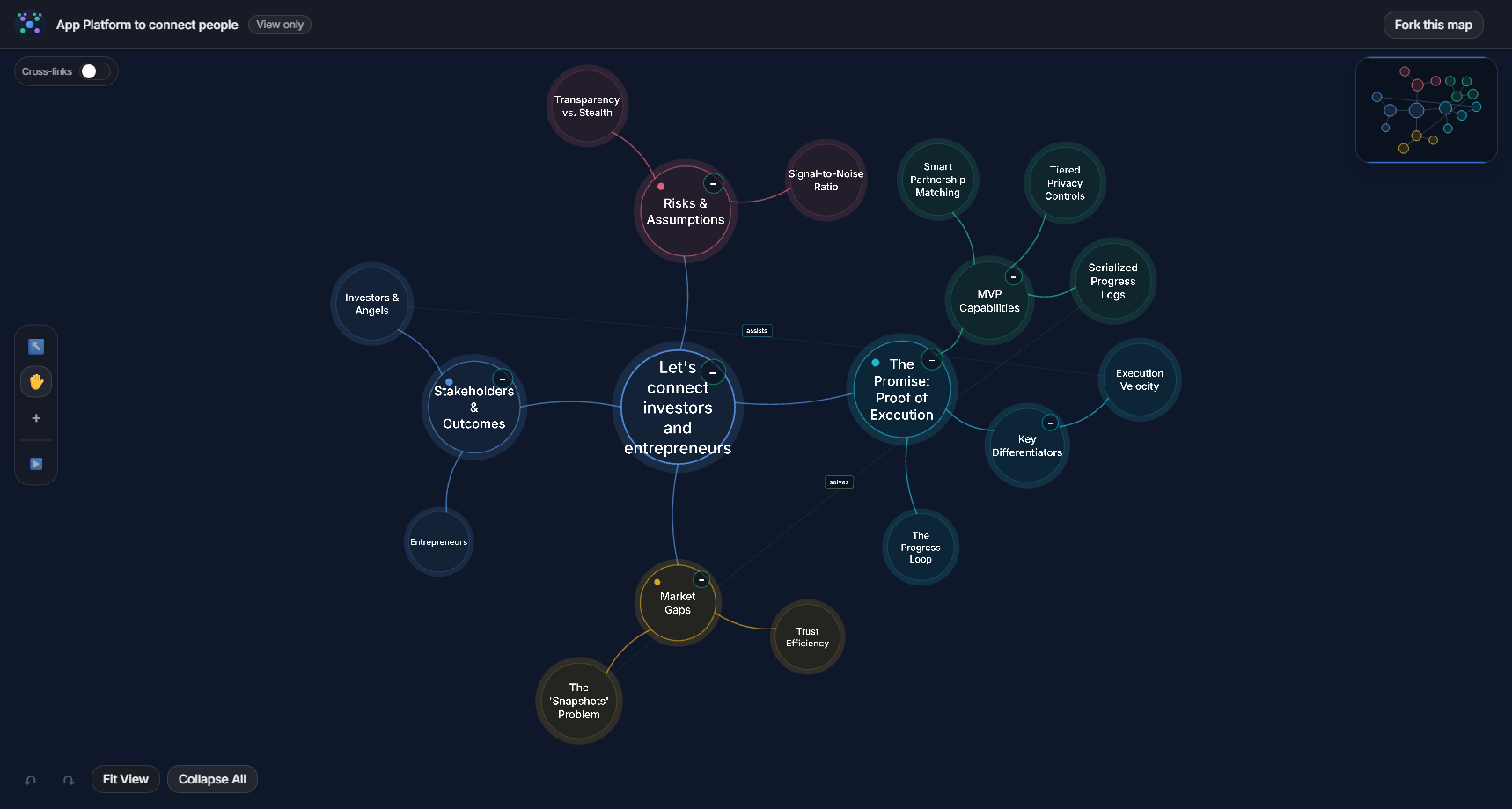
If code becomes abundant, the bottleneck moves upstream: clarity and alignment. Teams don't usually fail because they can't produce enough output. They fail because people are working from different mental models of the same problem.
DeeplyClear is my attempt to help solve that. Not by adding more text, but by making the structure of thinking visible and shareable.
It will evolve. But even in its current form, it's already been legitimately useful in my own work. I have dozens of maps; some I revisit repeatedly, and others that helped me refine ideas and discover connections I would have missed in a document.
Why mind maps — and why they're not enough
Mind maps aren't new. Tony Buzan popularized them in the 1970s. The insight was simple and hasn't changed: your brain doesn't think in bullet points. It thinks in associations, radiating outward from a central concept, branching and connecting in patterns that don't flatten neatly into paragraphs.
Mind maps make thinking visible. That's powerful.
But here's the thing: they're still static. You can see the structure, but you can't share the journey. How did you get here? Why does this branch matter more than that one? What's the flow of reasoning that connects these ideas?
You end up screenshotting a map and dropping it in Slack with zero context. Or you hop on a call to "walk someone through it"; which defeats the purpose of making it visual in the first place.
The structure is visible. The narrative is missing. That's the gap.
Clarity Tours: the missing piece
This is what I built DeeplyClear around.
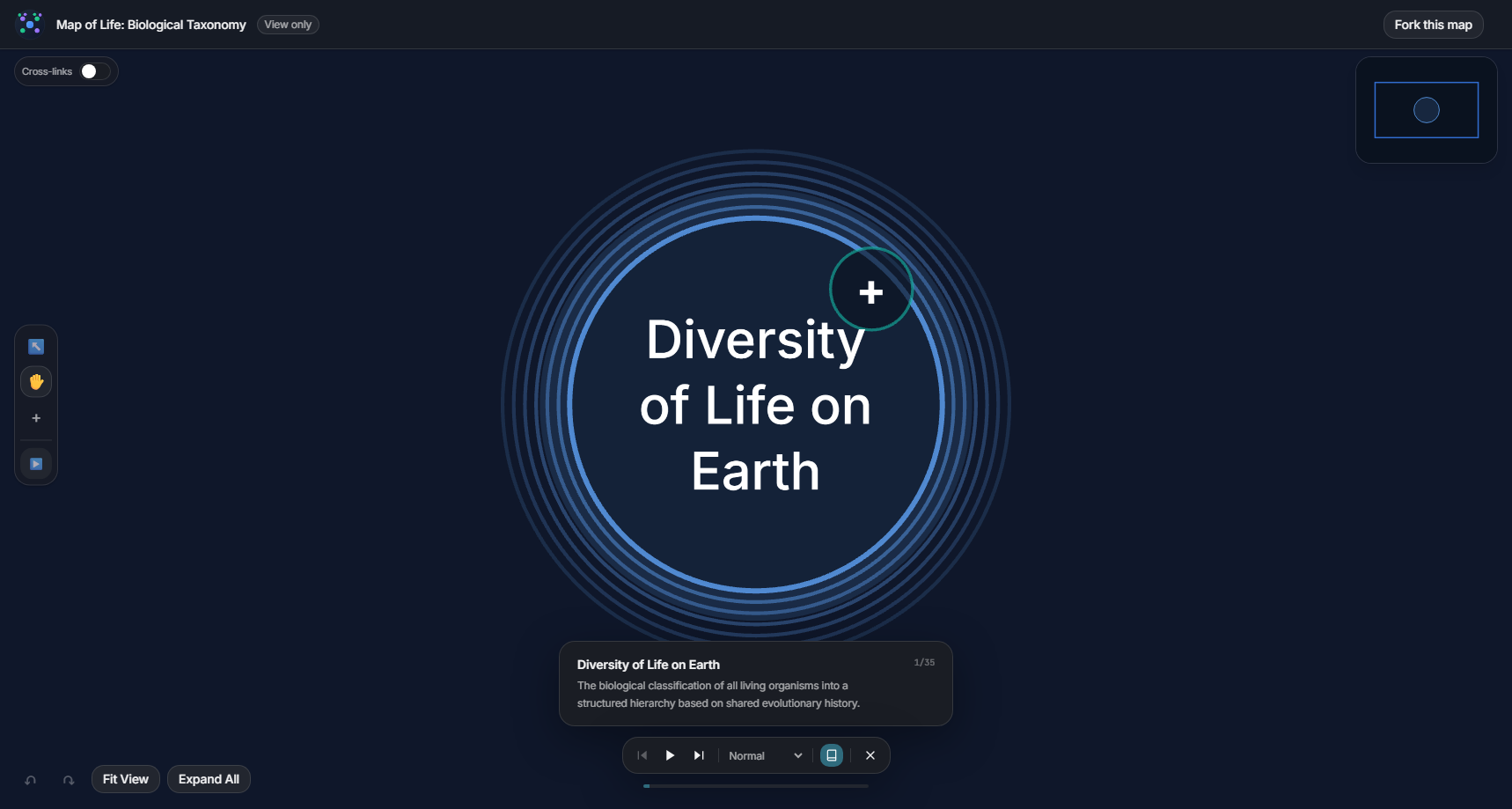
A Clarity Tour turns your mind map into an animated walkthrough. You set the order, add captions, and press play. The camera pans and zooms through your thinking, collapsing and expanding branches as it goes, revealing captions word by word.
Share a link. The viewer watches your idea unfold as a narrative, then explores the full map on their own.
It's the difference between sending someone a document and walking them through it on a whiteboard. Except the whiteboard walkthrough scales to anyone, anywhere, anytime.
No other mind mapping tool does this. Think of it as "Prezi for mind maps" — presentation mode that actually explains your thinking.

How DeeplyClear works
Clarity Tours are the headline, but they sit on top of a full AI mind mapping workflow:
Start messy
Describe your idea in plain language. Paste your notes. Drop a stream-of-consciousness paragraph. DeeplyClear doesn't need clean input.Messy is the whole point.
AI structures it
The AI decomposes your input into a mind map. Not a template, an organic breakdown where depth and branching follow the natural complexity of the topic.
Some branches go five levels deep where the idea is rich. Others stop at one. The AI finds fault lines, follows interesting threads, and reveals connections that weren't obvious in the text.
This is fundamentally different from note-taking AI that summarizes or organizes prose. DeeplyClear makes structure visible.

Refine on the canvas
The map renders on an infinite canvas powered by PixiJS. Nodes are physics-based bubbles that settle into natural positions through force-directed layout. You can:
- Drag to rearrange
- Click empty space to add nodes
- Collapse branches to focus on what matters
- Style with colors and sizes
- Connect nodes across branches
It runs smooth and feels responsive; even with 100+ nodes. This matters more than it sounds: a sluggish canvas breaks the flow of thinking.

Collaborate in real-time
Share your map and co-edit with others. See their cursors moving live. Keep feedback anchored to the right node instead of buried in a comment thread.
This is where real value emerges: when everyone can see the same structure, alignment happens faster. You discuss the idea on the idea, not in a separate thread about the idea.
Share as a Clarity Tour
Once your map captures your thinking, create a Tour to share it. Set the sequence, write captions for each stop, and publish. The Tour becomes a shareable URL: your idea, explained on your terms, at any viewer's convenience.
Use it with agents
DeeplyClear is also becoming a better companion for agentic work. You can connect it to tools like ChatGPT, Codex, Claude Code, Cursor, and other MCP clients, then ask an agent to create or update a map inside your workspace while it works through a problem with you.
This is especially useful if you are vibe coding internal software: admin panels, support tools, workflow automation, dashboards, approval flows, back-office systems, CRM-like tools, and all the unglamorous software that quietly runs a company.
Agents are good at producing code. But they can still lose the plot. A map gives the work a shared shape before the code hardens around the wrong assumptions.
Some useful patterns:
- Map the internal system before building. Ask an agent to turn a messy prompt into entities, roles, states, workflows, screens, and edge cases before it starts writing code.
- Understand an existing codebase. Point an agent at a repo or feature area and ask for a map of the architecture, data flow, permissions, integration points, and risk points.
- Design admin tools without drowning in tickets. Paste requirements, bug reports, customer notes, or Slack threads and turn them into a map of jobs, users, workflows, and missing decisions.
- Keep implementation aligned. As the agent edits code, ask it to update the same map with new assumptions, trade-offs, open questions, and follow-up work.
- Hand off context. Turn the finished map into a Clarity Tour so another teammate can understand the feature without reading the entire conversation or reverse-engineering the PR.
For internal software, this matters because the hard part is rarely "can we generate a table, form, or endpoint?" The hard part is knowing what the tool is supposed to make obvious, what should be impossible, who owns each decision, and where the workflow can break.
DeeplyClear gives the agent something visual to maintain: not just a chat transcript, but a living model of the system you are building.
Why not just use [other tool]?
vs. Note-taking apps (Notion, Obsidian, etc.): Great for capturing and searching text. But text hides structure. When your goal is to understand the shape of an idea, what depends on what, where the complexity lives, which parts are settled and which are open — a visual map beats a document.
vs. Traditional mind mapping tools (MindMeister, Miro, etc.): Most are manual. You drag, connect, arrange. DeeplyClear's AI generates the initial structure, so you start with something meaningful instead of a blank canvas. And nothing else has Clarity Tours. The ability to turn a map into a guided narrative.
vs. AI chat tools (ChatGPT, etc.): AI chat gives you more text. DeeplyClear gives you structure. The output isn't paragraphs to read, it's a map you can navigate, collapse, share, and present.
Under the hood
For the technically curious:
PixiJS powers the canvas. WebGL over SVG because SVG struggles beyond ~50 nodes with real-time physics. The trade-off is harder text rendering, but the smooth 60fps experience is worth it.
Convex handles the database, real-time sync, and server functions. Real-time subscriptions, optimistic mutations, and server-side logic in one platform. Excellent for a solo developer who doesn't want to manage infrastructure.
AI SDK with structured streaming means the map builds in real-time as the model generates. Nodes appear one by one, already positioned and connected. The model outputs a typed schema, not freeform text, which makes the UX dramatically more reliable.
The TourSequencer is a custom state machine that orchestrates camera movements, node uncollapsing, caption timing, and transition types (sibling pans vs. branch-change zooms). It was the most complex piece to build; getting the pacing right required extensive iteration.
The backstory
I'm José de Freitas, product director at MUI, passioned software engineer and game designers with 15 years in tech, and DeeplyClear came from my own frustration with alignment in product work.
I've sat through hundreds of meetings where smart people talked past each other because they were building different mental models from the same doc.
Visual thinking, being able to point at connection and say "this is what I mean", collapses that ambiguity. And Clarity Tours take it further: now you can walk someone through your reasoning without being in the room.
Building it as a solo dev has been one of the most fulfilling things I've done recently. Every pixel, every interaction, every API route, all one cohesive vision of how a thinking tool should feel.
Pricing
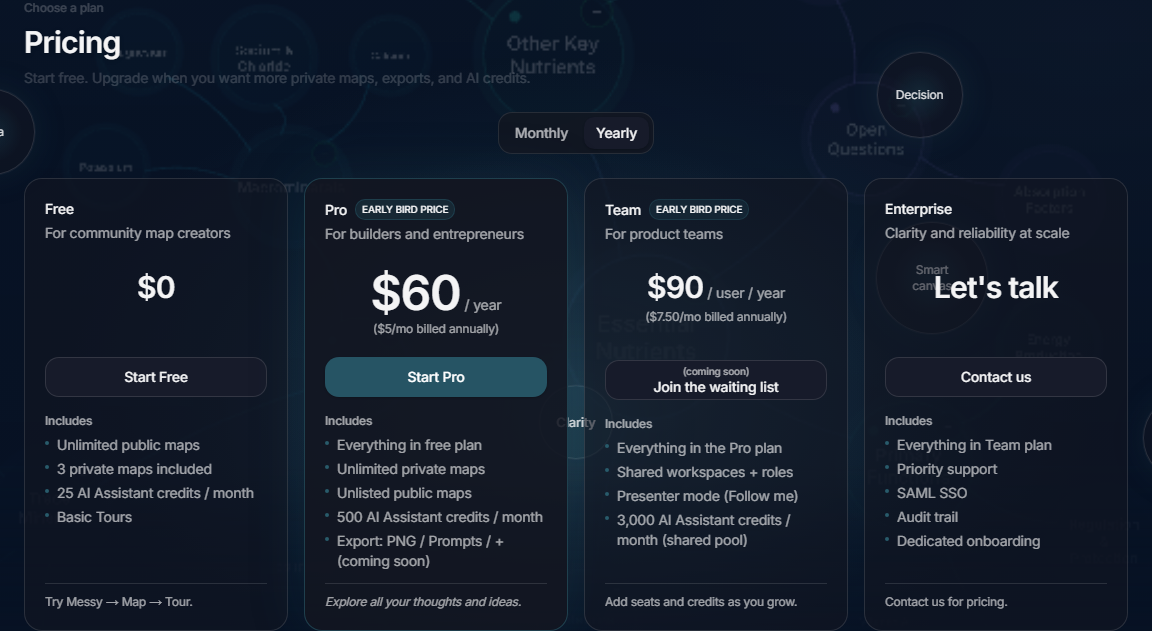
- Free: Unlimited public maps, 20 private, 50 AI Assistant messages/month
- Pro ($9.90/month or $60/year): Unlimited private maps, 500 AI Assistant messages, exports
No credit card to start. No feature walls on the core experience.
What's next
- Team workspaces — shared maps with roles and pooled AI credits.
- More exports — SVG, PDF, prompt export.
- Presenter mode — live "follow me" walkthroughs for meetings.
- Your request – I want to hear from you.
Try it
DeeplyClear is available now — free to start, no credit card required.
If you've ever stared at a doc and thought "I know there's a structure in here, I just can't see it" — this is for you.
Start a map. Describe your messiest idea. Watch it become clear. Then share a Clarity Tour and let others see your thinking unfold.
→ deeplyclear.com — free, no credit card, no friction.